Sue Anyone, anytime. Stop Paying Lawyers $300/hr
for This
You don't need a lawyer to fight. For $99, you can sue anyone in California.
- California Superior Court
- One price per case, no subscription
- Free until you file
- English and Spanish
- 01Tell us what happened.Speak it or type it. Plain English or Spanish, no legal words needed.
- 02We build your packet.Answer, complaint, demand letter, fee waiver, every form the court expects, filled out the way the clerk wants it.
- 03Send it or file it.Suing, being sued, or collecting a judgment, your finished packet is ready the same day.
Just talk.
No forms to figure out and no legal words to look up. An attorney voice asks you six questions and listens to the answers.
- 01
Tell me what happened to you. Take your time - start from the beginning.
Describe the incident, who was involved, and when it happened.
- 02
Got it. Now I need a few details about you. What's your full name, address, and the best way to reach you?
Full name, street address, city, zip, phone, and email.
- 03
Who did this to you? Tell me their name - and if it's a business, the business name and any address you know.
Person name, business name, or both.
- 04
What proof do you have? Texts, emails, photos, contracts, medical records, witnesses - anything at all.
List every piece of evidence you can access.
- 05
What has this cost you? Medical bills, lost wages, money out of pocket, emotional pain, tell me everything.
Include dollar amounts where you know them.
- 06
Last one, and it's optional, is there anything else the court should know that I didn't ask you about?
Anything my questions missed. Leave it blank if nothing comes to mind.
Most people never sue because the paperwork is scary and they don't know their rights. Answer the questions and you hold that bastard accountable.
Prefer to type? Every question takes typed answers too.
This is what you file.
Real California pleading paper and the Judicial Council forms that go with it. Twenty-eight numbered lines, the caption box, the footer on every page, the format the clerk is trained to look for.
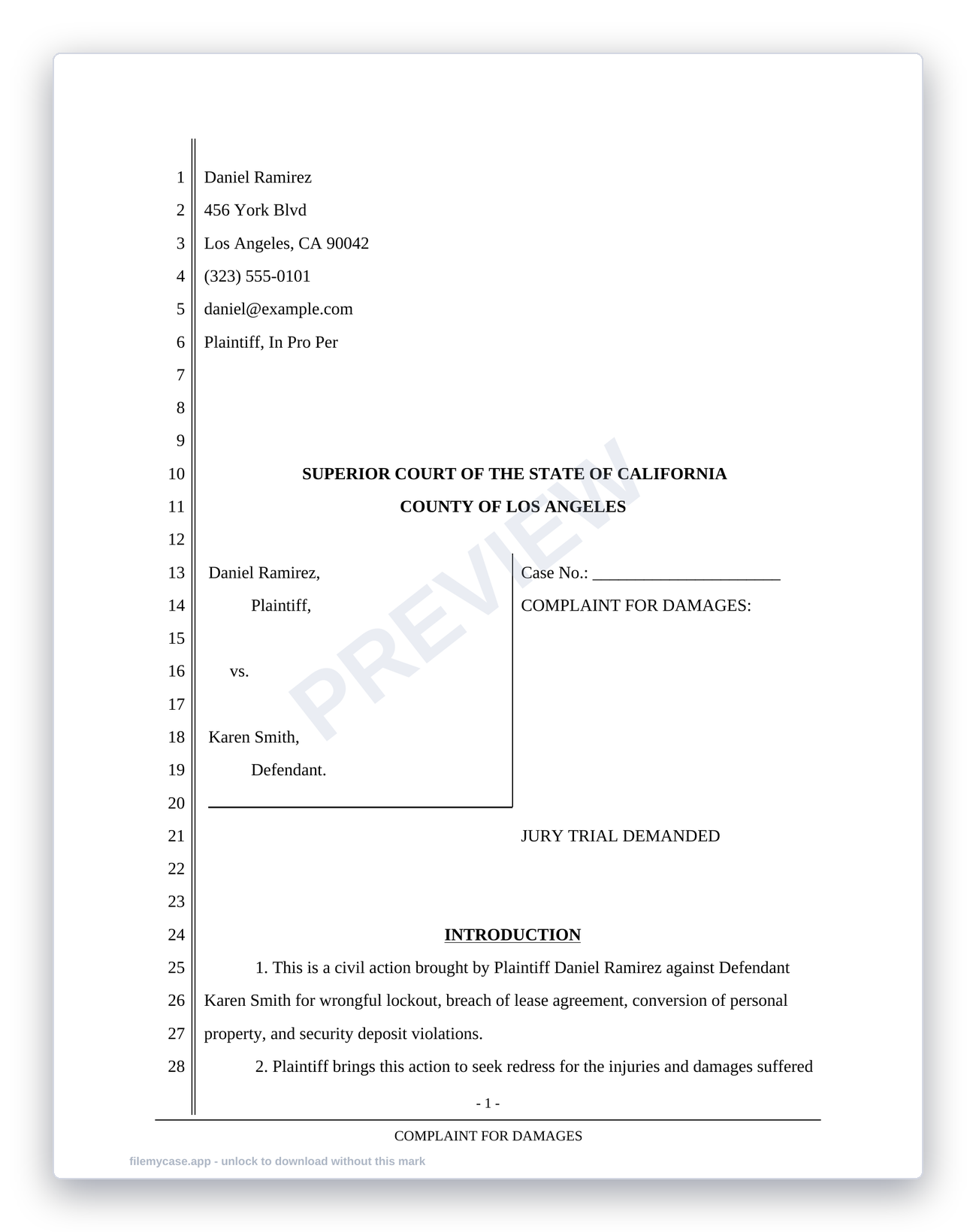
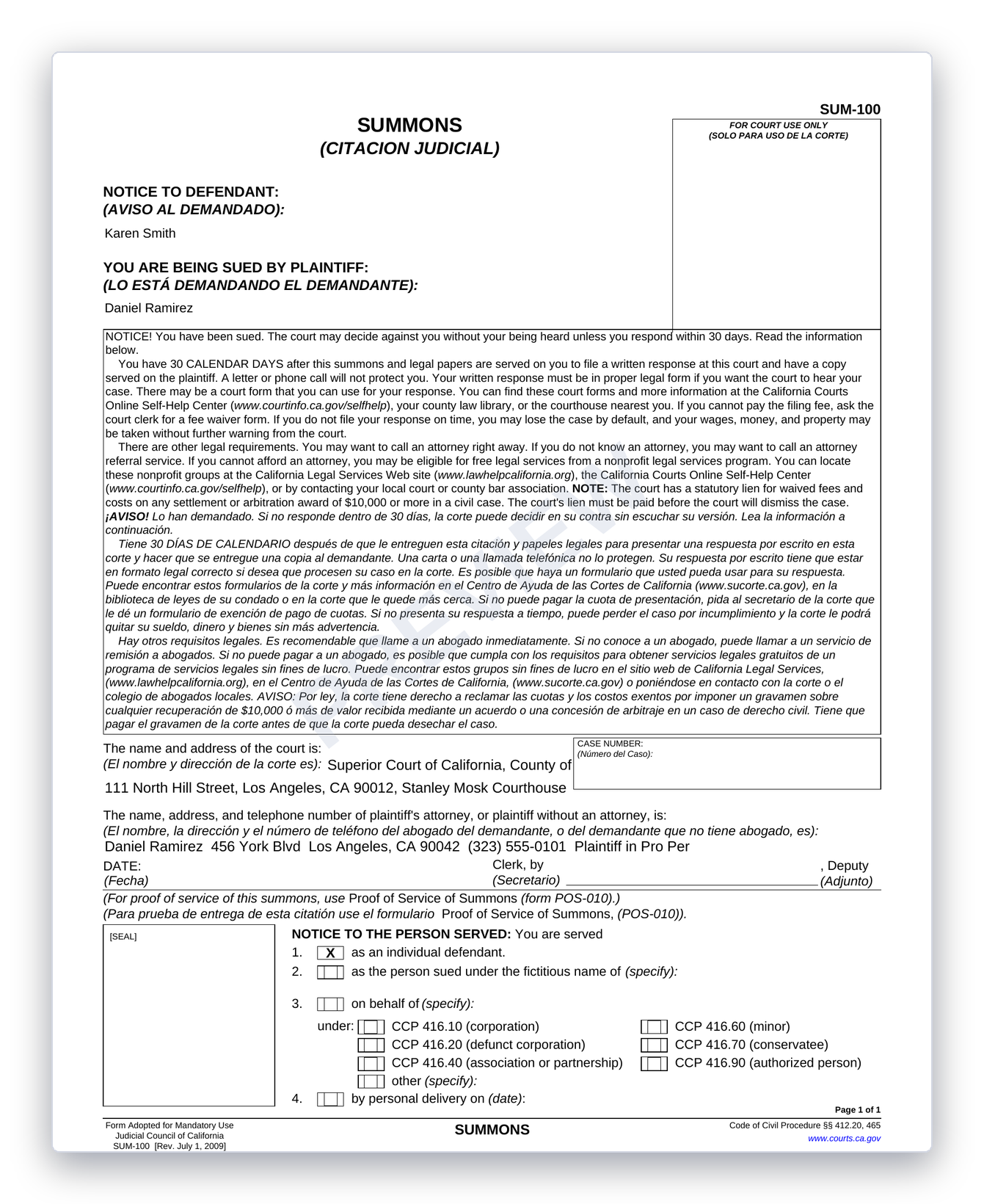
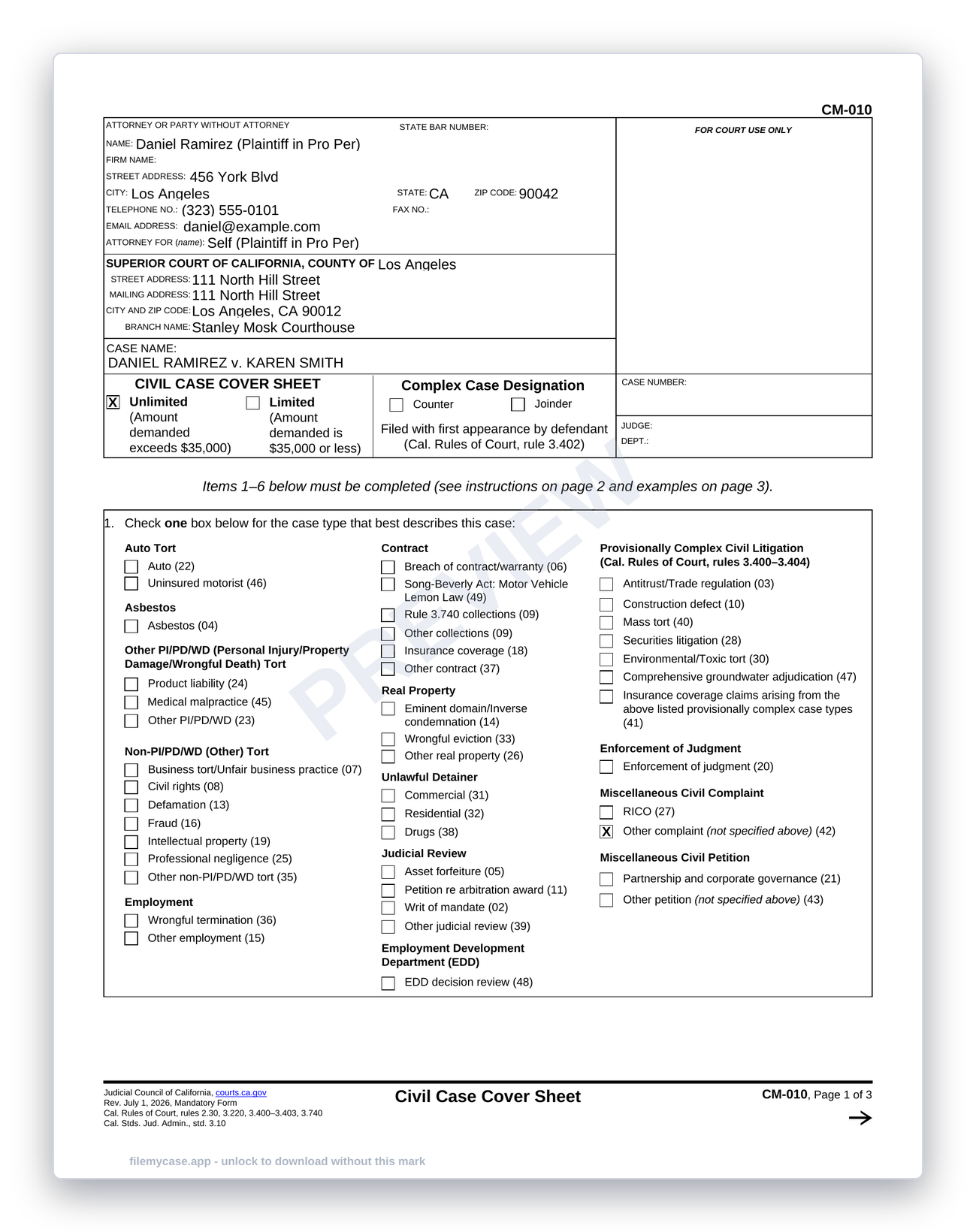
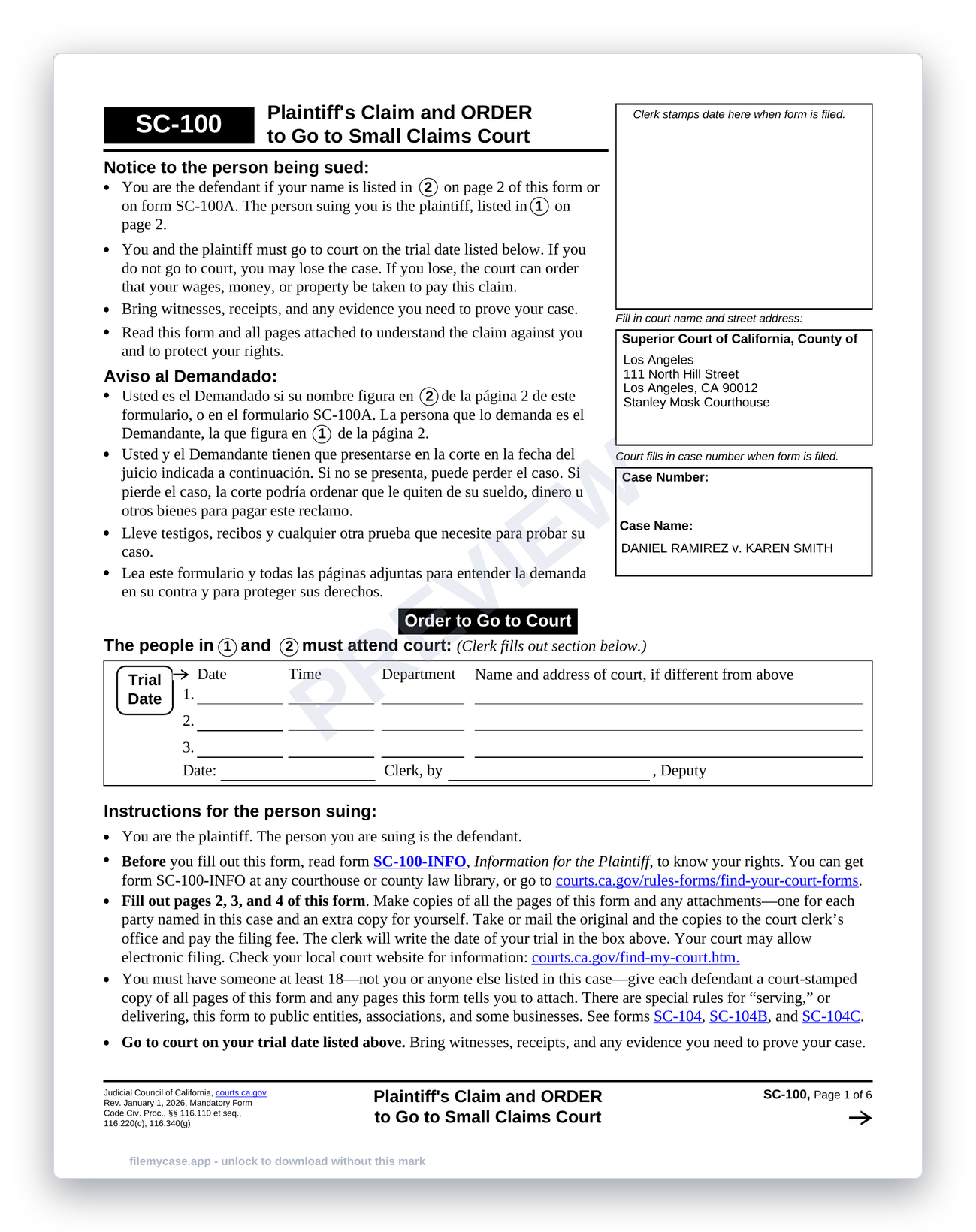
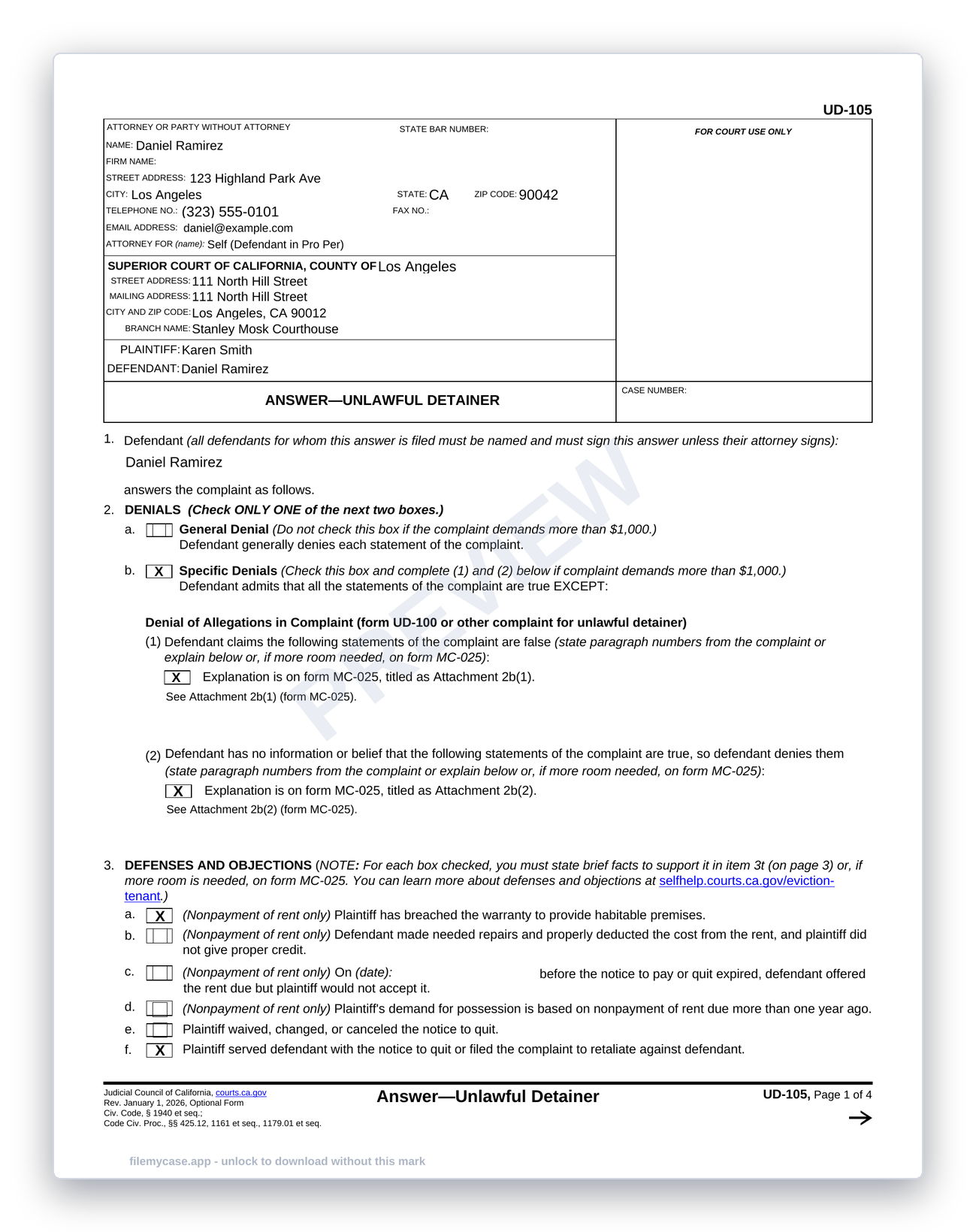
Sample packet, watermarked. Every page is generated from your own answers.
Everything you file.
Your answers decide the track and the paperwork. Here is what a packet looks like, the exact list is generated for your case, never guessed.
Civil lawsuit
For claims over $12,500. Filed in Superior Court.
- How to File This Packetyou keep this
Plain-English checklist: where to go, what to bring, what it costs.
- Civil Case Cover SheetCM-010
Tells the clerk what kind of case this is. Required on every new civil filing.
- SummonsSUM-100
The official notice served on the defendant giving them 30 days to answer.
- Complaint
Your lawsuit, on 28-line California pleading paper with a footer on every page.
- Request to Waive Court FeesFW-001
Asks the court to waive the filing fee based on income or public benefits.
- Order on Court Fee WaiverFW-003
The judge's ruling page that goes with FW-001. Filed blank.
- Proof of Service of SummonsPOS-010
Filed after service to prove the defendant received the papers.
- Demand Letteryou keep this
Send this before you file. A written demand settles many cases without a filing fee, and dates your request for payment.
Small claims
For claims up to $12,500. No lawyers allowed on either side.
- How to File This Packetyou keep this
Plain-English checklist: where to go, what to bring, what it costs.
- Demand Letteryou keep this
Send this before you file. Small claims requires you to ask for payment first.
- Plaintiff's Claim (Small Claims)SC-100
In small claims this one form is the entire lawsuit, no separate complaint.
- Request to Waive Court FeesFW-001
Asks the court to waive the filing fee based on income or public benefits.
- Order on Court Fee WaiverFW-003
The judge's ruling page that goes with FW-001. Filed blank.
- Proof of Service (Small Claims)SC-104
Filed blank. Whoever serves the defendant fills it in and signs it.
- How to Serve a BusinessSC-104Cyou keep this
The official guide for serving a business defendant. Keep it, don't file it.
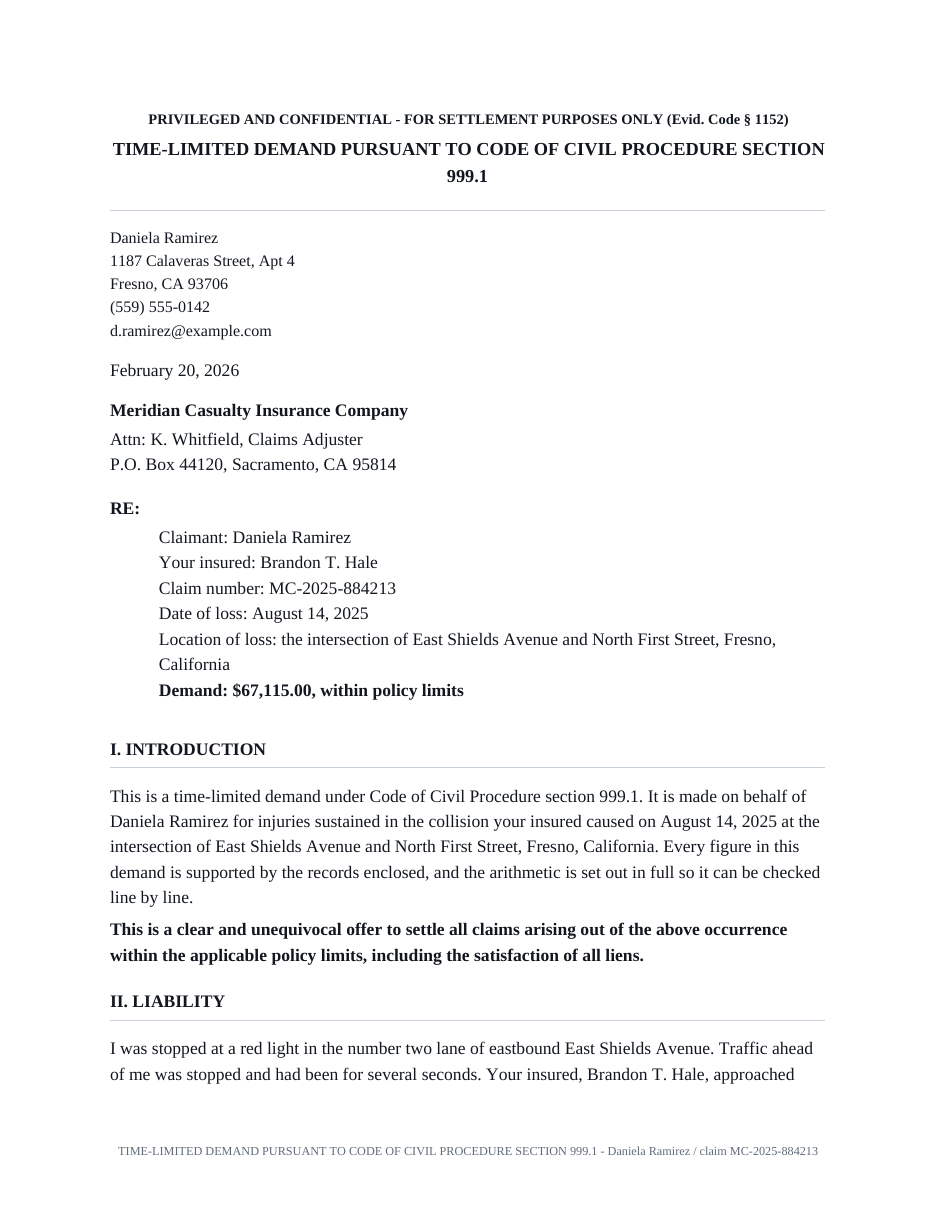
Car accident demand
Sent to the insurance company, not the court. Nothing here is filed, and no attorney takes a third of your settlement.
- How to File This Packetyou keep this
Plain-English checklist: where to go, what to bring, what it costs.
- Medical Records and Billing Requestsyou keep this
One letter per provider. California gives you 15 days to get your own records, and the billing ledger is what proves your number.
- Transmittal and Proof of Transmissionyou keep this
Rides on top of the mailed package and records the date, so the carrier cannot argue about when the clock started.
- Time-Limited Demand Letteryou keep this
The settlement demand under Code Civ. Proc. § 999.1. Meeting the statute is what puts the carrier at risk if it ignores you.
- Damages Worksheetyou keep this
Line-by-line arithmetic behind the demand: billed, adjusted, and recoverable, plus what you would actually keep.
- Index of Enclosures and Exhibit Tabsyou keep this
The proof the statute requires, indexed and tabbed so the adjuster reads it instead of skimming it.
- Exhibitsyou keep this
Every exhibit behind its own lettered tab, with the files you uploaded bound in place, so the adjuster never has to hunt for a bill.
- Property Damage Demandyou keep this
Vehicle damage is a separate file with a separate adjuster. Paying it does not release your injury claim.
- Your Negotiation Scriptyou keep this
Your demand, target, and walk-away number, with what to say when the first offer comes in low. Keep this, never send it.
Judgment collection
You already won. This is how you actually get paid.
- How to Collect Your Judgmentyou keep this
What you are owed today with interest, the date your judgment expires, and the order to work the counters in.
- Abstract of JudgmentEJ-001
The clerk issues it, you record it with the County Recorder. It liens any real property the debtor owns in that county for ten years.
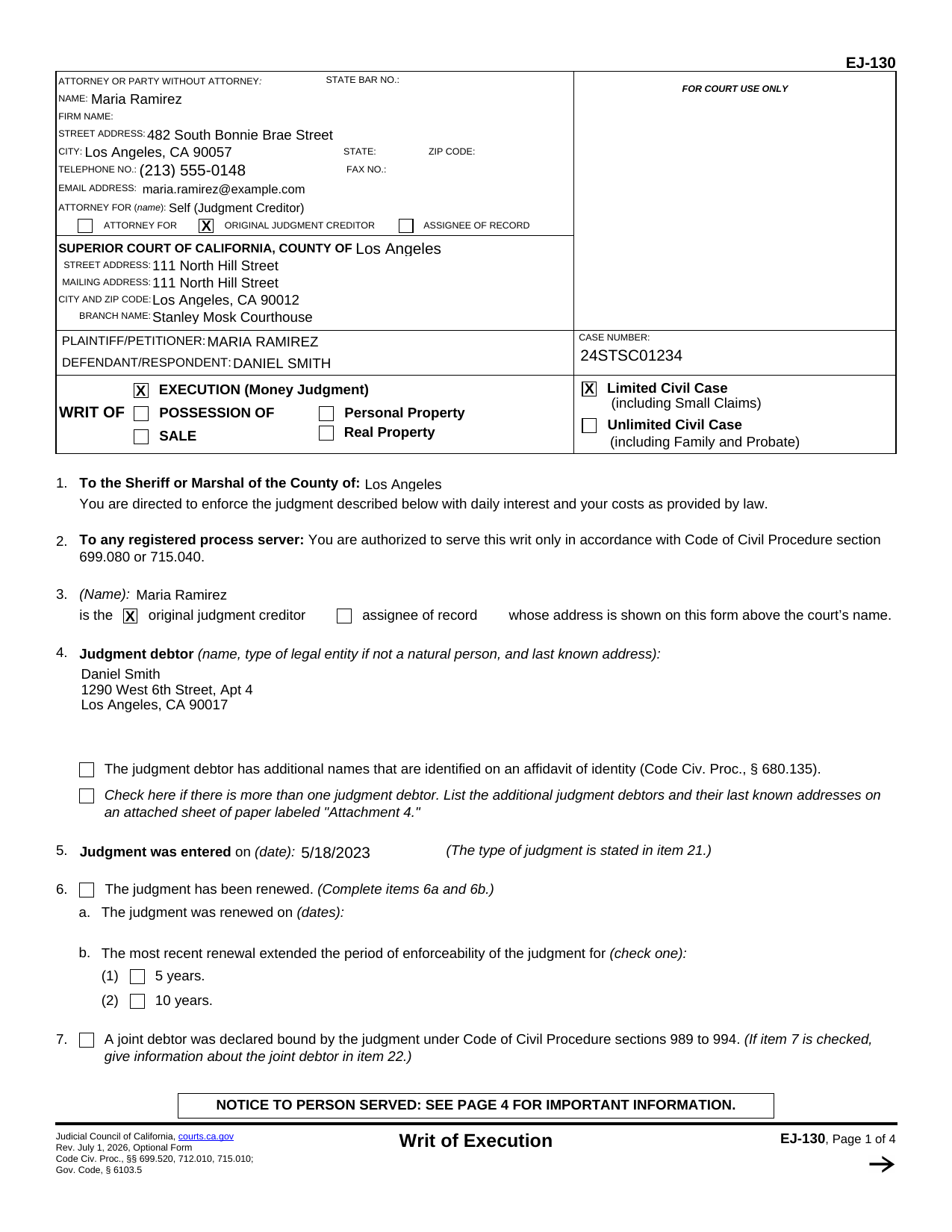
- Writ of ExecutionEJ-130
The order that lets a sheriff actually take money. Nothing gets levied without it, and it expires 180 days after issuance.
- Application for Earnings Withholding OrderWG-001you keep this
Goes to the sheriff with the writ. The employer then withholds up to 20% of the debtor's disposable pay every period.
- Memorandum of Costs After JudgmentMC-012
Adds your issuance and sheriff fees, and accrued interest, onto the judgment so the debtor pays for the collection.
Beat the collector
Your answer to a collection lawsuit, filed before the default hits.
- How to File This Packetyou keep this
Plain-English checklist: where to go, what to bring, what it costs.
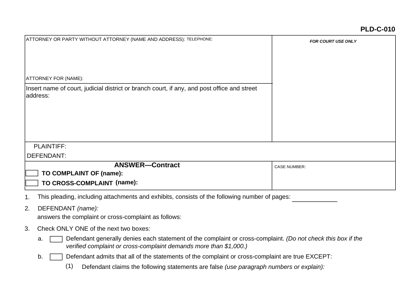
- Answer - ContractPLD-C-010
Your answer to the debt lawsuit. Filing it stops a default judgment and makes the collector prove the debt is yours.
- Attachment to Judicial Council FormMC-025
Continuation pages for the answers that don't fit on the lines UD-105 gives you.
- Request to Waive Court FeesFW-001
Asks the court to waive the filing fee based on income or public benefits.
- Order on Court Fee WaiverFW-003
The judge's ruling page that goes with FW-001. Filed blank.
- Proof of Service by First-Class MailPOS-030
Proves a copy of your answer was mailed to the landlord. An adult who isn't you signs it.
Eviction defense
Your answer to an unlawful detainer, filed on the court's clock.
- How to File This Packetyou keep this
Plain-English checklist: where to go, what to bring, what it costs.
- Answer - Unlawful DetainerUD-105
Your defense to the eviction. Filing it stops a default judgment and gets you a trial.
- Request to Waive Court FeesFW-001
Asks the court to waive the filing fee based on income or public benefits.
- Order on Court Fee WaiverFW-003
The judge's ruling page that goes with FW-001. Filed blank.
- Proof of Service by First-Class MailPOS-030
Proves a copy of your answer was mailed to the landlord. An adult who isn't you signs it.
Starting at
$99
One price. One case.
You pay once, for the case you're filing. A California attorney runs about $400 an hour, and drafting a complaint takes several of them.
If the court waives your filing fee, you pay our lowest price on any court track. The car accident demand is not filed with a court, so a waiver does not change its price.
The court’s own filing fee is separate and goes to the clerk, not to us. We tell you what yours will be before you go, and prepare the fee waiver if you can’t afford it.
Answer the questions and read your draft first. Pay only when you want the packet.
Before you start.
- Are you a law firm?
- No. file my case is not a law firm and does not give legal advice. We prepare your documents from the answers you give us, the way a document preparation service does. You are representing yourself, which California courts call appearing in pro per.
- Who can read my case?
- Only you. Your answers and documents are encrypted and tied to your account, and no other user can reach them. We never sell your information.
- What if the clerk rejects my filing?
- Tell us what the clerk said and we regenerate the corrected packet at no charge. Most rejections come from formatting or a missing form, which is exactly what this is built to prevent.
- Which counties do you cover?
- All 58 California counties. The complaint, summons, and cover sheet are statewide Judicial Council formats, and we set the caption and courthouse for the county you choose.
- Do I still have to go to court?
- You file the packet yourself, in person, by mail, or through your county's e-filing portal, and we give you a plain-English checklist for each. If the case goes to a hearing, you attend it.
- Can I get my money back?
- If we can't produce a filable packet for your case, you don't pay. Once you've downloaded the finished packet the work is delivered, so refunds after that are handled case by case.
- Can I do this in Spanish?
- Yes. The whole interview, the questions, and the instructions are available in Spanish. Your court documents are written in English because California courts require English filings, and your packet includes a Spanish guide explaining each one.
Case too big to file yourself?
Injury, six-figure damages, or criminal exposure — those belong with a lawyer, and we'll point you to firms that handle them.